You’re posting consistently. You share useful information and invest time into creating valuable content for your audience.
But when it comes to enquiries, leads, or sales, the results are not what you expected.
So, what’s missing?
If you’re trying to figure out how to create content that converts, there’s one mistake most people don’t even realise they’re making.
A lot of content online today is educational. It’s valuable. It teaches and informs.
But the truth most product business owners avoid is that educational content alone will not grow your business.
As a creative content strategist and founder of The CCS Brand, I’ve seen this pattern repeatedly, especially among founders trying to simplify their marketing and show up online with confidence.
Educational content is an important part of content marketing. It helps people discover your business, understand their problems, and learn about possible solutions.
But if you want your content to contribute to business growth, you also need to consider what you want people to do with the information you’re sharing.
In this article, I’ll break down how to create content that converts, the difference between content that educates vs content that converts, and how you can build a simplified marketing system that actually works, whether you’re new to content creation or you’re a product-based business owner in the UK.
Creating Content That Converts Starts With Understanding Educational Content
Educational content helps your audience understand something they want or need to know.
This type of content plays an important role in marketing. It introduces people to your business, demonstrates your knowledge, builds trust, and helps potential customers understand their options.
Content that educates often looks like:
- “How to create a content plan”
- “Five ways to care for your skincare products”
- “What to consider before buying handmade furniture.”
- “Best Instagram content strategy for growth”
For example, a skincare business might publish a post explaining how to build a simple skincare routine. Someone who discovers the post might find the information useful and begin following the brand.
That is a valuable outcome, even if the person doesn’t buy anything immediately.
However, there is a difference between helping someone understand a topic and helping them take the next step towards working with your business.
Educational content answers questions, but it rarely tells people what to do next.
Many product based business owners and founders feel stuck here. You’re doing everything right, but nothing is converting.
That’s where conversion-focused content comes in.
Conversion-focused content encourages a specific action that supports your business goal. Actions can be to join an email list, book a call, make an enquiry, or purchase a product.
What Is Conversion-Focused Content (or Content That Converts)?
The content does not just share information. In other words, content that converts is about adding direction.
Let’s go back to our skincare business example. An educational post might explain how to build a skincare routine as a beginner.
A conversion-focused post could explain how to choose products for your skincare routine if you have acne-prone skin, then introduce the business’s relevant products, and direct readers to explore the collection.
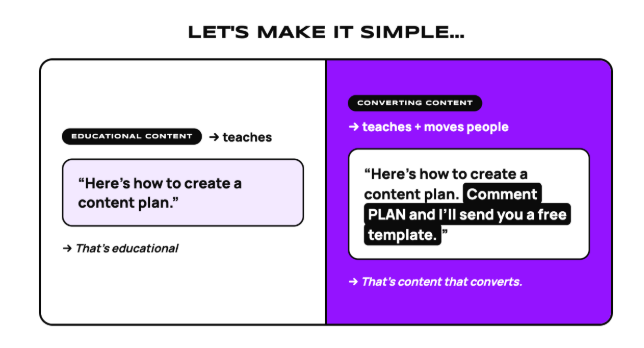
Both approaches can educate the audience. The difference is how the content connects that information to an appropriate next step.
This doesn’t mean every post needs to sell something.
Sometimes, the most useful next step is to save a post or learn more about the business. What matters is that the action makes sense for the content and the audience.
One of the most important things you need to make your content convert is clear messaging. If you don’t have that yet, put it high up on your to-do list. I created a template to make it much easier for you to clarify your messaging. (It’s free!). Get The Messaging Clarity Workbook
How to Create Content That Converts in 5 Practical Steps
Now that you understand the difference between educational content and content that converts, the next step is to apply that understanding to the content you create.
1. Start With the End Goal.
Before you post, ask yourself: What do I want this content to do?
- Get comments?
- Reach a new audience?
- Drive traffic?
- Answer customer objections?
- Build an email list?
Having a clear objective helps you make better decisions about the subject, message, format, and call to action. If you don’t know the goal, your audience won’t know what to do.
2. Add a Clear Call to Action.
A call to action tells your audience what they can do next. Examples:
- “Comment PLAN for the template”
- “Save this for later”
- “DM me ‘STRATEGY’”
This gives your audience a clear direction and turns interest into action. Note that one clear, relevant next step is enough for a post.
3. Build a System, Not Random Posts.
This is where many product business owners miss the mark.
Posting daily without a structure is not a social media strategy. It will not bring the kind of results you desire. The solution is to move from reactive posting to a structured system.
This guide on creating a content plan using a calendar will teach you how to build a sustainable content system for your product business.
4. Combine Education With Conversion.
You don’t need to stop educating in your content. You simply need to teach + direct.
Your audience should be able to understand what your business offers and why it is relevant to them. Connect the information you share to the value your business provides.
For example, a business selling handmade candles creates an educational post on choosing scents for different rooms. A conversion-focused post can explain how to choose a scent, introduce relevant candles from its collection, and invite readers to explore the available options.
5. Stay Consistent Without Burning Out.
This is where simplified marketing matters. You don’t need 10 platforms, a daily posting routine, or a complex system to create content that converts consistently.
You need clarity, a simple system that fits your business needs and available resources, and the tips we’ve discussed so far.
If you’d like to go further, Neil Patel has a great step by step guide sharing strategies to create high-converting content. Read it here: Creating Content That Converts: The Step-by-Step Guide
Conclusion
The CCS Brand is the creative agency for busy product business owners, service providers, and founders. We bring your ideas to life through strategy, storytelling & visual content. We handle the creative work behind the scenes so you can focus on doing what you love (running your business!). Learn more about how we increase online visibility and sales for your business.

I am Fatimah Owodunni, and my goal is to help business owners and founders move from posting reactively to building a content system with clarity, intention, and purpose. I believe content should support your business goals, not compete with your energy or time. If this article helped you think differently about showing up online, share it with someone who needs to hear it today.
Follow me on Instagram for daily content tips. Visit YouTube for in-depth breakdowns and tutorials.