
Does creating content every week feel like starting from scratch?
If you nodded yes, lack of ideas may not be your main problem. You simply need a better plan.
You’re likely familiar with content calendars, but there’s one thing most business owners get wrong. A content calendar can help you organise what you’re publishing, but opening a blank calendar and filling it with random post ideas isn’t really content planning.
A useful content plan starts before the calendar. You first decide what your business needs from its content, who you want to reach, which topics you need to own, and how those ideas can be turned into different pieces of content.
Then the calendar becomes what you need, which is a practical system for turning the plan into consistent content.
In this article, I’ll walk you through how to create a content plan, how to use a content calendar to organise it, and how to build a system that makes creating content easier to manage over time.
How to Create a Content Plan Using a Content Calendar Step by Step
When you sit down to plan your content, the goal is not to open a calendar and start filling dates. Doing that can give you a full calendar without your content being strategic. Each content in your calendar should have a purpose.
If you keep thinking “I don’t know what to post” or “I have ideas but I need a system,” follow these steps to create a content plan that works as a system for your brand.
Step 1: Brainstorm Ideas and Refine
The first step to create a content plan is always brainstorming. I brainstorm ideas with my team, talking through what’s happening in my business, what the audience needs, and what content makes sense right now.
This stage is important because a content plan should reflect reality, not pressure. Brainstorming helps you surface relevant topics that align with both your audience’s needs and your business goals. It will also reinforce why your brand needs a content plan instead of reacting to trends or posting randomly.
As you brainstorm, think about questions you get from your audience, concerns your prospective clients bring up, useful information that your audience needs but may not have access to, and offers your brand is trying to sell or promote. These pointers can help you generate some very solid ideas.
Once I have a few topic ideas, I use AI to help refine them. This does not replace my thinking. Instead, it makes ideas clearer and more structured. You can use your preferred AI tool to refine and flesh out your ideas. This step supports clarity without removing originality.
Step 2: Outline Your Goal and Calendar
After brainstorming and refining ideas, I open my content calendar. This is where planning actually starts. One of the biggest mistakes people make when learning how to create a content plan is skipping this step or using the calendar incorrectly.
The first thing is to write down your goal. What would you want your content to help your business achieve? For example, do you want content to increase awareness? Educate potential customers? Build trust and credibility? Drive traffic to your website?
Then, list the topics you will create content around for the week. Don’t worry about being detailed yet. Just focus on outlining clear topic titles. This should be based on the refined ideas that you gathered in Step 1 during brainstorming.
This approach answers a key question many beginners ask: what is a content plan? At its core, a content plan connects topics to your business goals before execution. It is a system for the content your business creates and publishes.
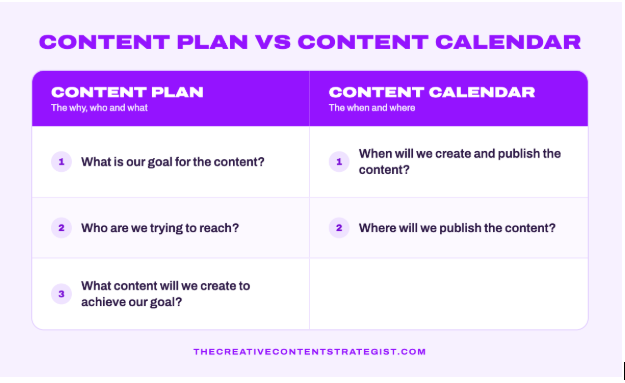
For a deeper explanation of the strategic side of content planning, read this article on why your small business needs a content plan and learn the mindset shift that makes planning effective instead of overwhelming: Why Your Small Brand Needs a Content Plan (Not Just Cute Graphics)
Step 3: Script Your Content
Once you’ve decided what you want to talk about, think about how the idea should be delivered. Your topic can be a blog, a carousel, a reel, or even a text post. Now, you can expand each topic into full scripts, blogs or social media copy.
When it’s time for scripting, I don’t write inside my calendar. Instead, I use a separate Google Doc to write my scripts properly, without cluttering the calendar. This separation is intentional and is a key part of how to create a content plan that remains usable.
Think of it this way. The content calendar is for visibility and organisation. The Google Doc is for thinking, scripting, and clarity. Once my topics are clear, I flesh them out for each platform. This keeps planning simple and execution focused.
Need help creating your first content calendar? GoDaddy has a helpful guide: Why you need a content calendar and how to create one
To make the process easier, use this free content calendar template I use every month.
How to Create a Content Plan That Stays Sustainable Over Time
The value of a content plan is more obvious when it is realistically executable for the business. This varies for everyone, so you need to consider your schedule, capacity, and resources, to make sure you don’t end up burnt out or overwhelmed.
One trusted way to make your content plan sustainable is to create one that makes repurposing a natural part of the system. Repurposing removes the extra load of creating content platform by platform.
This is how I made repurposing part of my content plan. For YouTube, I always create a long-form video on the topic. For Instagram and TikTok, I break that YouTube video into a shorter version. For LinkedIn, I turn the same topic into either an article or a carousel. For my website, I expand it into a long blog post.
For example, this blog teaches you how to create a content plan using a content calendar. I can adapt it into a LinkedIn carousel explaining the difference between a content plan and a content calendar. I can also script a reel on three signs you are creating content without a plan. Then, I can expand that into a YouTube video discussing how I build content plans for product-based business owners in the UK and around the world.
This way, I’m not creating new ideas for every platform. I’m repurposing one topic across different formats. This is a practical example of what a content plan is in action: one idea, multiple executions, all aligned to a single goal.
Check out HubSpot’s guide on content planning that explains how it improves consistency, performance, and long-term results for growing brands: How to build a content marketing plan in 7 steps
This is how I plan my content using a content calendar: brainstorm first, refine the ideas, outline the goal, then organise everything clearly.
From experience, content creation does not feel hard because you lack ideas. It feels hard because there is no structure supporting your ideas. Learning how to create a content plan replaces guesswork with clarity.
Did this article help you understand how to create a content plan and why your brand needs one? Share it with someone. Explore more free resources on content marketing here, where I break down simple systems that actually work for beginners and small teams.
Conclusion
The CCS Brand is the creative agency for busy product business owners, service providers and founders. We bring your ideas to life through strategy, storytelling & visual content. We handle the creative work behind the scenes so you can focus on doing what you love (running your business!). Learn more about how we increase online visibility and sales for your business:

I am Fatimah Owodunni, and my goal is to help business owners and founders move from posting reactively to building a content system with clarity, intention, and purpose. I believe content should support your business goals, not compete with your energy or time. If this article helped you think differently about showing up online, share it with someone who needs to hear it today.
Follow me on Instagram for daily content tips. Visit YouTube for in-depth breakdowns and tutorials.